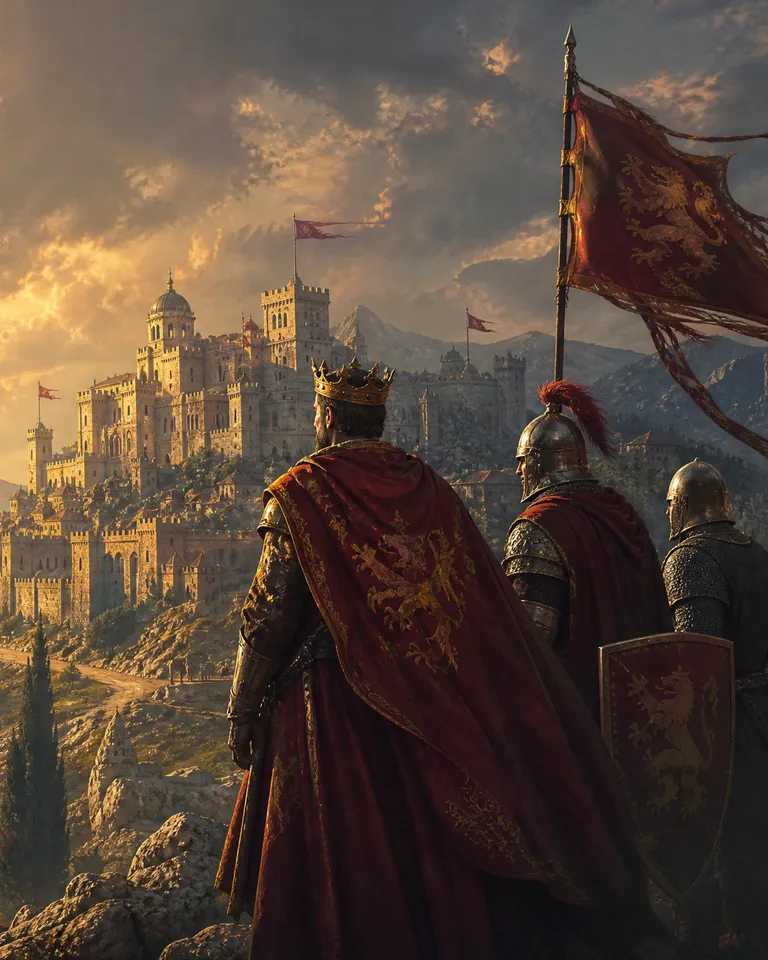
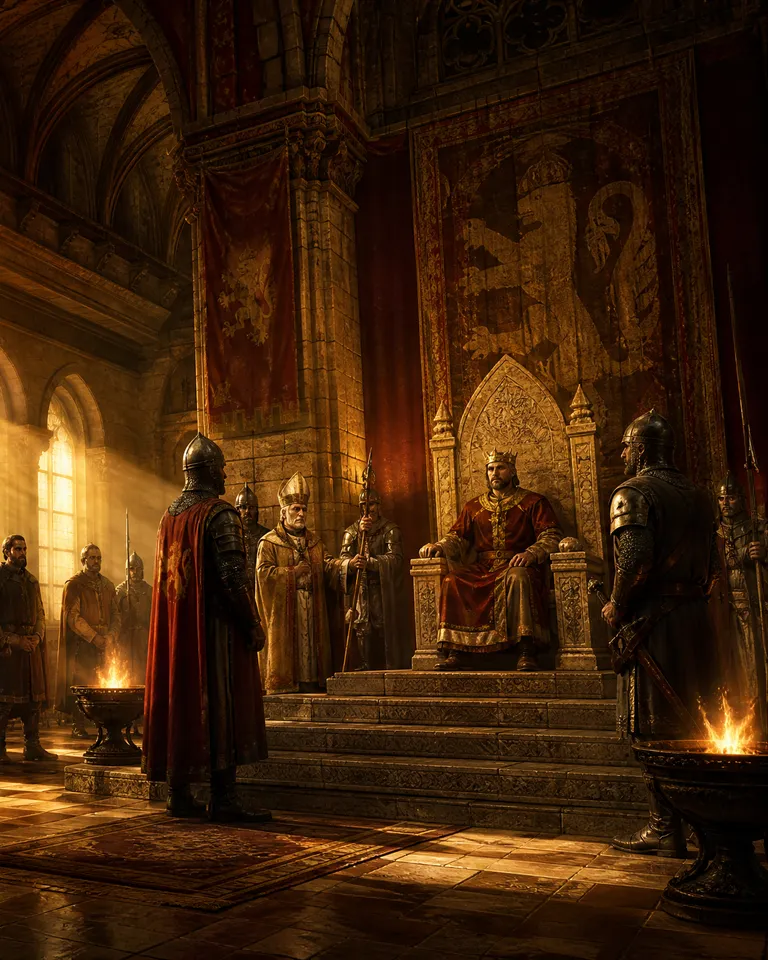
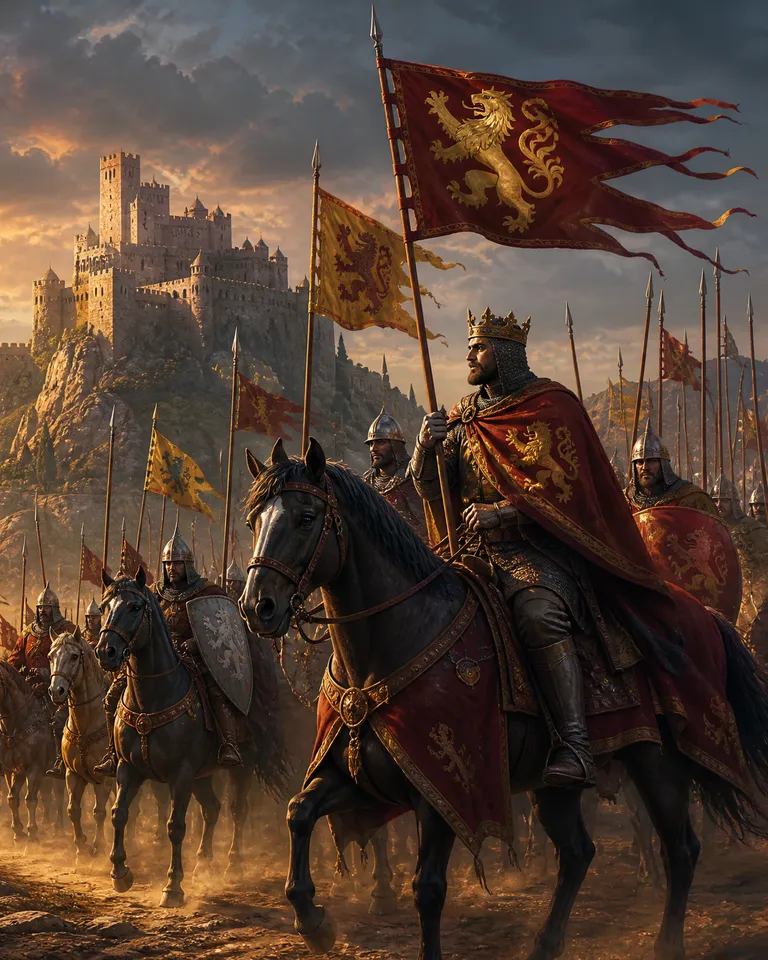
Kings don't rule alone.
Real-time grand strategy, 1097–1300. You hold one office of three — the treasury, the seals, or the army — under a king you did not choose.
Real-time grand strategy, 1097–1300. One office of three, under a king you did not choose.
- 1–3 players per kingdom
- 3 Offices
- 45 Realms
- 281 Provinces
- PC
In development. Test builds go out in waves.
Read on ↓
Transcript
One kingdom. Three players. And an army already at the gates.
One of you takes the treasury. One takes the seals. One takes the army. No one takes all three.
Forty-five realms. Two hundred and eighty-one provinces. All of it moving at once — no turns, no waiting for anyone.
Grand strategy in real time. Break their walls. Starve their armies.
Or end a bloodline over dinner.
Your king is old. When he dies, the three of you vote — and only one of you can wear it.
The map
Two hundred and eighty-one provinces.
Europe, Anatolia, the Levant, North Africa. Terrain that decides battles before they start — rivers you cross badly, hills you hold well. Political, terrain and religious map modes.
No abstraction, no hex grid. The coastline is the coastline.
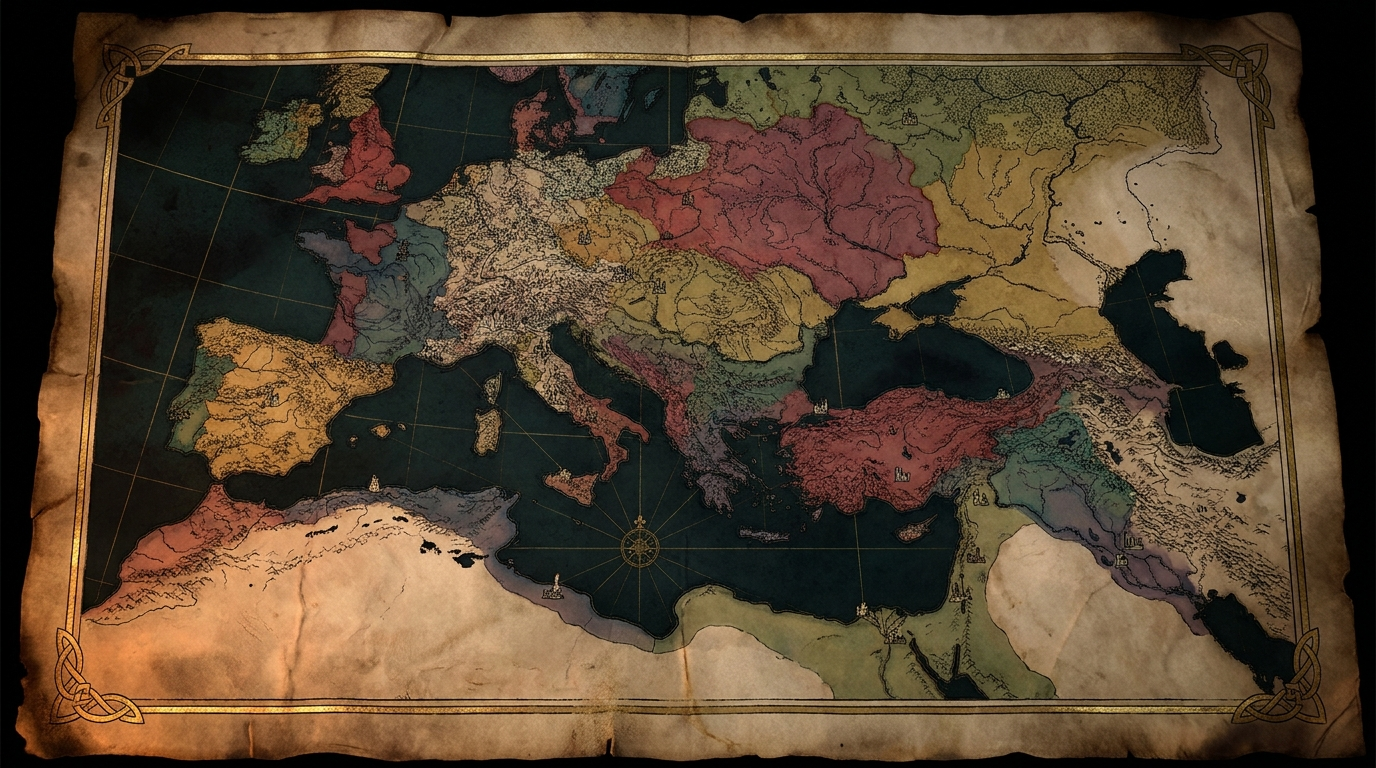
- Constantinople
- Antioch
- Tbilisi
- Cairo
- Palermo
- Kyiv
The rules
No hidden dice.
- The simulation is deterministic.
- Same seed, same result, every time. Nothing is rolled against you in secret.
- Difficulty is a number you set.
- At higher difficulty, AI realms receive a stated resource multiplier. You never receive one. That is the entire cheat, and you chose it.
- No rubber-banding.
- Nobody catches up because you're ahead. If you're winning, you're winning.
- You choose the end.
- 1150, 1200, 1250 or 1300. Victory by points, by domination, or by score at the end year. The campaign concludes. You get a result.
Access
Ask to be let in.
Test builds go out in waves. Places are limited — we'd rather have fifty people playing properly than five thousand bouncing off a build that isn't ready.
Everyone on the list gets development updates. Not everyone gets a build in the first wave. You'll know which you are.
The list opens shortly.
Access requests aren't open yet. Nothing you type here is recorded or sent. Come back in a few days — or follow the studio, and you'll see when it opens.
Questions
The ones people actually ask.
Is this Crusader Kings?
No. There's no character roleplay, no dynasty simulation, no 3D characters. You hold one office of three — the treasury, the seals, or the army — not a whole realm and not a single character. The combat maths owes something to CK3 — the rest doesn't.
Is it Knights of Honor 2?
That's the closest relative and we won't pretend otherwise. The court and the real-time pacing come from the same tradition. What's different: 281 provinces instead of a hundred-odd, a simulation that publishes its own rules, campaigns with a stated end year, and a kingdom run by three offices under a king you don't begin as — when he dies, the three of them elect his successor.
Is it a map-painter?
Painting the map is one way to lose. Take too much and coalitions form, infamy climbs, and provinces you can't govern revolt. Territory without administration is a liability.
Can I play it now?
Not yet. Test builds go out in waves to people on the list.
When does it release?
No date. A release date for a game at this stage would be a guess, and we'd rather not guess at you.
How much will it cost?
Not decided. It won't be forty-five dollars.
Is there a Steam page?
Not yet. When there is, everyone on the list hears first.
Will there be multiplayer?
Yes, and it's actively being built — lobby sessions with humans and AI realms in one world. The three offices are not part of that, and not a mode: every kingdom has them from the first turn, single-player included. Humans take them first; AI fills the rest.
Why is there no gameplay in the trailer?
Because it's an early cinematic and we'd rather say so. The gameplay trailer comes when the game looks the way it should — recorded from the actual build, no dressing.
Mac? Linux? Steam Deck?
Windows first. The engine makes the others possible; nothing is promised until it's tested.
Mods?
The game is data-driven — provinces, realms, units and buildings are all editable files. Proper mod support is intended, not promised.
Is the artwork AI-generated?
Yes, generated and then hand-corrected. The game's province map is built from public-domain geographic data, and the simulation — every formula, every system — is written and tested by hand. If that's a dealbreaker for you, we'd rather you knew from this page than found out later.
Is it historically accurate?
The map, the realms and the cultures are researched. The systems are a game, not a thesis. Kings die on schedules history didn't keep.